System Map
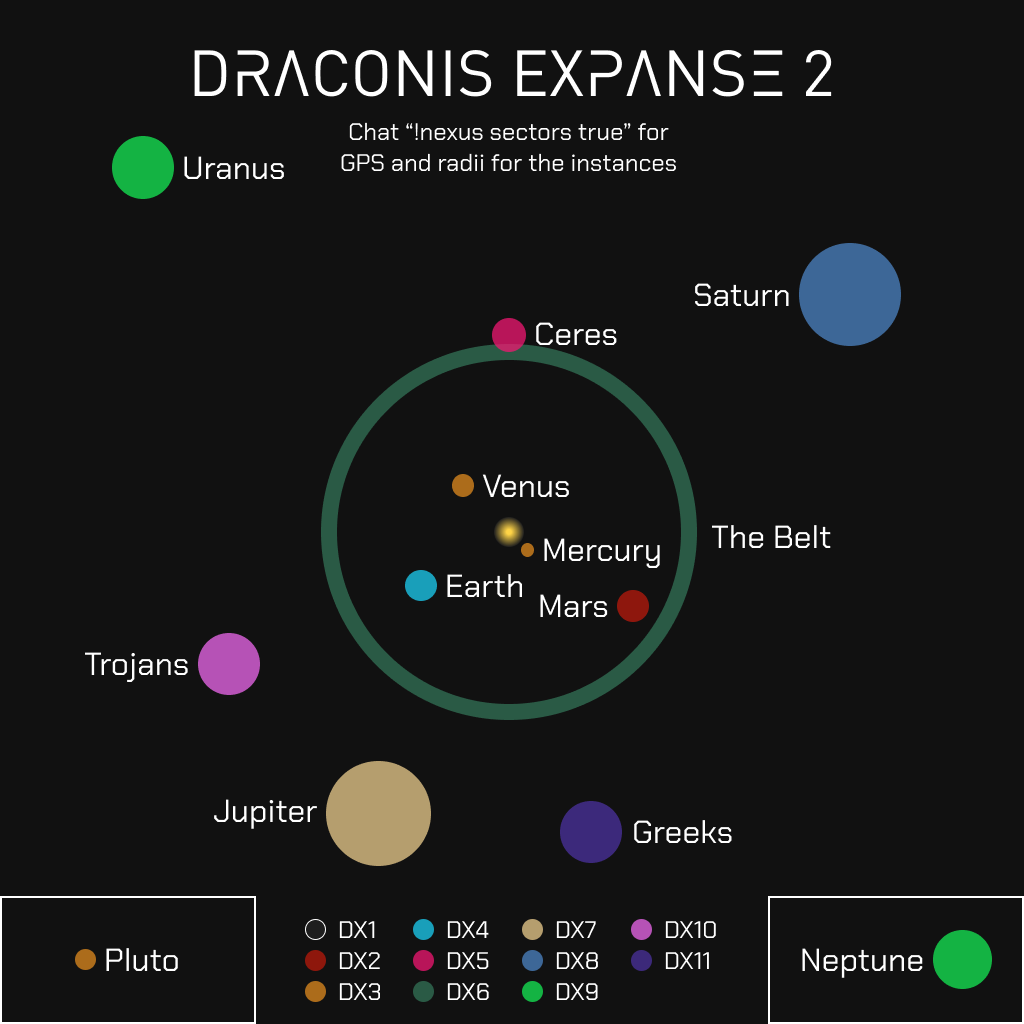
Asteroids can be found in The Belt, Trojans, Greeks and the rings of gas giants (Jupiter, Saturn, Uranus)
NPC Trade Stations must be found by you. If you get within several hundred km of one, it will show up as ‘Unidentified POI’. Visit it to have its location added to your Hand Terminal.
Inner Planets
Mercury
Mercury is the first planet from the Sun and the smallest in the Solar System. It is a rocky planet with a trace atmosphere and a surface gravity slightly higher than that of Mars.
Venus
Venus is the second planet from the Sun. Similar in size and mass to Earth, Venus has no liquid water, and its atmosphere is far thicker and denser than that of any other rocky body in the Solar System. The atmosphere is composed mostly of carbon dioxide and has a thick cloud layer of sulfuric acid that spans the whole planet.
Earth
Earth is the third planet from the Sun. It is an ocean world, the only one in the Solar System sustaining surface water. Most of Earth's land is at least somewhat humid and covered by vegetation. Earth's crust consists of slowly moving tectonic plates, which interact to produce mountain ranges, volcanoes, and earthquakes.
Earth is the cradle of humanity, home to about 30 billion people.
Luna
The Moon is the only natural satellite of Earth.
Earth is the home world to the United Nations (UN), and therefore off limits to their enemies.
Neutral players may visit the outer, low-security zone around the homeworld.
Mars
Mars is the fourth planet from the Sun. It is a desert-like rocky planet, containing some water in the ground as well as thinly in the atmosphere, but no bodies of liquid surface water. Its surface gravity is roughly a third of Earth's or double that of the Moon. Fine dust is prevalent across the surface and the atmosphere. The terrain of Mars roughly follows a north–south divide, with flat, low lying plains in the north and cratered highlands in the south.
Mars was a colony of Earth, but has since gained independence. The terraforming project is a driving force of Martian society, involving most of the population either directly or indirectly.
Phobos
Phobos is the innermost and larger of the two natural satellites of Mars.
Deimos
Deimos is the smaller and outer of the two natural satellites of Mars.
Mars is the home world to the Martian Congressional Republic (MCR), and therefore off limits to their enemies.
Neutral players may visit the outer, low-security zone around the homeworld.
The Belt
Asteroids
The Asteroid Belt, often referred to as The Belt, also known as the main asteroid belt, is a torus-shaped region in the Sol system, located roughly between the orbits of Mars and Jupiter.
In the past, Ice could be found here, but all of it has been mined to fuel the expansion of humanity across the Sol System.
Ceres
Ceres is a dwarf planet between the orbits of Mars and Jupiter. It is classified as the only dwarf planet of the asteroid belt, and the largest without a moon.
Ceres was one of the first sites of human colonization and is now the most important port in the belt. The dwarf planet was spun up to generate 0.3 g of artificial spin gravity.
Ceres is the home world to the Outer Planets Alliance (OPA), and therefore off limits to their enemies.
Neutral players may visit the outer, low-security zone around the homeworld.
Eros
Eros is a stony asteroid between the orbits of Mars and Jupiter. It is the first discovered and second-largest near-Earth object. It has an elongated shape.
Eros was one of the first sites of human colonization and was once the most important port in the belt, a title now lost to Ceres. The asteroid was spun up to generate 0.3 g of artificial spin gravity.
Hygiea
Hygiea is a large asteroid between the orbits of Mars and Jupiter. It is the fourth-largest main-belt asteroid by both volume and mass.
Pallas
Pallas is the third-largest asteroid in the Solar System by volume and mass. It is the second asteroid to have been discovered, after Ceres, and is likely a remnant protoplanet.
Pallas Station, one of the oldest ports in the Belt, has a long history as a refinement station for the local mining operations.
Vesta
Vesta is one of the largest objects in the asteroid belt, thought to be the second-largest asteroid, both by mass and by volume, after the dwarf planet Ceres.
It hosts one of the largest settlements in the Belt.
Outer Planets
Jupiter
Jupiter is the fifth planet from the Sun, and the largest in the Solar System. This is a gas giant with a mass nearly 2.5 times that of all the other planets in the Solar System combined and slightly less than one-thousandth the mass of the Sun. Its diameter is 11 times that of Earth and a tenth that of the Sun.
Jovian Moons
Callisto
Callisto is the second-largest moon of Jupiter and the third-largest in the Sol system. The colony has a mining industry and several large civilian and military shipyards.
Europa
Europa is the smallest of its four Galilean satellites, but still the sixth-largest moon in the Sol system. It has a human settlement, which grows vegetables and beef in big greenhouses and supplies food to the Belt.
Ganymede
Ganymede is the largest moon in the Sol System. Ganymede Station was one of the first permanent human settlements in the outer planets, built as a long term colony with large domes filled with food crops. It is known as the safest station in the Jovian system, and many humans from other colonies travel to Ganymede to deliver their babies.
Io
Io is one of the moons of Jupiter and the fourth largest moon in the Sol system, slightly larger than Luna. It is the innermost of the Galilean moons, the main group of Jupiter's moons that were discovered first. There are numerous volcanoes across the moon that spew molten silicate into the atmosphere. Io houses research labs and supplies power cells to the Belt.
Saturn
Saturn is the sixth planet from the Sun and the second largest in the Solar System, after Jupiter. It is a gas giant, with an average radius of about 9 times that of Earth. Even though Saturn is almost as big as Jupiter, Saturn has less than a third of its mass.
The planet has a bright and extensive system of rings composed of ice asteroids, rocky debris and dust.
Saturnian Moons
Dione
Fourth largest and an icy moon with, probably, a rocky core.
Enceladus
Sxth largest and an icy moon known for its geysers and cracks caused by Saturn's tidal pull.
Iapetus
Third largest and known for several unusual features, such as a massive equatorial ridge running three-quarters of the way around the moon.
Mimas
A rocky, spherical moon and seventh largest; know to be the smallest spherical object in the system.
Phoebe
Phoebe is a small ice moon with an irregular orbit. It was thought to have originally come from the Kuiper belt and captured by Saturn's gravity.
Rhea
Second largest moon and similar to Ceres in that it features hydrostatic equilibrium.
Tethys
Fifth largest, low density moon, and possibly mostly comprised of water-ice.
Titan
Known for its amazing dome resorts, its the largest saturnian moon. It comprises more than 90% of the mass in orbit around Saturn (including the rings).
Uranus
Uranus is the seventh planet from the Sun. It is a gaseous cyan-coloured ice giant. Most of the planet is made of water, ammonia, and methane in a supercritical phase of matter. The planet's atmosphere has a complex layered cloud structure and has the lowest minimum temperature of all the Solar System's planets.
Moons of Uranus
Ariel
Ariel is the fourth-largest moon of Uranus. Ariel orbits and rotates in Uranus's equatorial plane, which is almost perpendicular to the planet's orbit, giving the moon an extreme seasonal cycle.
Miranda
Miranda is the smallest and innermost of Uranus's five round satellites. Like the other large moons of Uranus, Miranda orbits close to its planet's equatorial plane.
Oberon
Oberon is the outermost and second-largest major moon of the planet Uranus. It is the second-most massive of the Uranian moons, and the tenth-largest moon in the Solar System.
Titania
Titania is the largest moon of Uranus and the eighth-largest moon in the Solar System.
Umbriel
Umbriel is the third-largest moon of Uranus.
Neptune
Neptune is the eighth and farthest known planet orbiting the Sun. It is the fourth-largest planet in the Solar System by diameter, the third-most-massive planet, and the densest giant planet.
Triton
Triton is the largest natural satellite of the planet Neptune. It is the only moon of Neptune massive enough to be rounded under its own gravity and hosts a thin, hazy atmosphere.
Pluto
Pluto is a dwarf planet beyond the orbit of Neptune. It is the ninth-largest and tenth-most-massive known object to directly orbit the Sun.
Charon
Charon is the largest known natural satellite of the dwarf planet Pluto.